Your Binosto® Treatment Guide

This treatment guide explains what Binosto is, why you have been prescribed it, and how to take it to treat your condition.

This website is designed to support you with your treatment and is not a substitute for the Patient Information Leaflet that came with your medication.

Binosto 70 mg (alendronic acid)

What is Binosto?

Binosto is an effervescent tablet, that contains the active ingredient alendronic acid (commonly known as alendronate), and treats osteoporosis in women after they have been through menopause, to help protect them from hip and spine fractures.1

About your treatment

Below you’ll find some helpful information which may answer some of the questions you may have about your condition and treatment with Binosto.

If you have any additional questions about your treatment, it is important to talk them through with a member of your healthcare team. Do not stop taking this medicine unless your Healthcare Professional tells you to do so. Please read the Patient Information Leaflet that comes in your Binosto pack for full details on how to take your treatment.

What is osteoporosis?

Osteoporosis is a condition where bones become weak and fragile, making them break more easily.2

Bone is living tissue that is constantly being broken down and replaced. Osteoporosis occurs when the production of new bone doesn’t keep up with the loss of your old bone.2

Imagine inside your bones is like a honeycomb. With osteoporosis, the holes in the honeycomb gradually become larger, making your bones become weaker over time.2

Most people don’t know they have osteoporosis until it causes them to break a bone. That’s why it is called a “silent disease”.2

Although fractures can occur in different parts of the body, the hip, wrist and spine are the most commonly affected sites.2

Why did I get osteoporosis?

Women are at a higher risk of developing osteoporosis than men because bone density is directly affected by the hormone changes that occur during menopause.3

The female hormone oestrogen is essential for healthy bones. After menopause, oestrogen levels fall, which can lead to a rapid decrease in bone density.3

As many as 1 in 3 women over the age of 50 will suffer a broken bone due to osteoporosis, so it is fairly common.4

What are the consequences of osteoporosis?

With enough force, anyone can break a bone. When you have osteoporosis, however, just a simple fall can result in a broken bone.5 While the hip, wrist and spine are the most affected sites, fractures can occur in other parts of the body.2

Spinal fractures – when the bones in your spine squash down on themselves, rather than breaking apart – from osteoporosis typically happen in the lower or middle back.5

Hip fractures are most common in people in their late 70s, but they can occur in younger people too.6

By taking your daily vitamin D and calcium treatment in the way your doctor has instructed you to, you can reduce the risk of suffering a hip fracture in the future.7

Why have I been prescribed Binosto?

As you age, your bone density tends to decrease because your body breaks down bone faster than it forms new bone.3 Binosto contains alendronate, which belongs to a group of medicines called bisphosphonates. They work by slowing down bone removal, so that bone-forming cells have time to rebuild new bone. This helps strengthen your bones and prevent future bone fractures.8

Contact your doctor, nurse or pharmacist if you have any questions about why you have been prescribed Binosto.

How do I take Binosto?

Binosto is a once-weekly effervescent tablet that you dissolve in water before taking.1

When you get up in the morning on your chosen day, before you have anything to eat or drink, completely dissolve one tablet in 120 ml of plain water. If need be, give it a stir to make sure the tablet is completely dissolved.1

Drink all the Binosto mixture in one sitting, followed by at least 30 ml of plain water (you can drink more plain tap water if you’d like). Then wait at least 30 minutes before having your first food or drink of the day and before taking other medication since other things in your stomach can stop Binosto from working properly.1

For that half hour, it’s also important that you don’t lie down – you need to sit or stand upright (or walk around) for the 30 minutes after you take Binosto.1

This will help the medicine reach your stomach and reduce the risk of unpleasant side effects or interactions with food or other medicines.1

Contact your doctor, nurse or pharmacist if you have any questions about how to take Binosto.

Why is Binosto dissolved in water?

Some people have problems swallowing tablets. If an alendronate tablet gets stuck on the way down, it can irritate or injure your oesophagus (the tube that connects your throat to stomach). Because Binosto is dissolved in water, you can avoid the problem of alendronate lodging in your oesophagus.1

Since you need to take Binosto on an empty stomach (see the next question), you should not mix Binosto into any other drinks apart from plain water.1

Why do I need to take Binosto on an empty stomach?

Alendronate is not an easy medicine for your body to absorb. If you have food or drink other than plain water before taking alendronate, it can bind to the medicine preventing it from getting to work for your bones. An empty stomach means that you absorb as much of the drug as possible.1

What difference does Binosto being “buffered” make?

Bisphosphonates can be irritating to the oesophagus and stomach because they are quite acidic. However, Binosto has a substance called a buffer added to make it less acidic. The buffer doesn’t change the medicine’s main effects, it just makes it less likely to cause irritation when you take it.1

Is Binosto okay for people with allergies/food sensitivities?

Binosto contains the following ingredients:1

  • Sodium dihydrogen citrate
  • Citric acid anhydrous
  • Sodium hydrogen carbonate
  • Sodium carbonate anhydrous
  • Strawberry flavour [Maltodextrin (Maize), Arabic gum, Propylene glycol (E 1520), nature-identical flavouring substances]
  • Acesulfame potassium
  • Sucralose

Binosto does not contain lactose, wheat, or ingredients made from rapeseed oil.1

The strawberry flavour comes from corn; the citric acid and monosodium citrate it contains are made from sugar beet and cane sugar.

Can I take Binosto if I am vegetarian/vegan?

Binosto is suitable for vegetarians and vegans as it does not contain any animal-derived ingredients.1

What should I do if I forget to take Binosto?

If you miss a dose, don’t worry. Just take Binosto as you normally would on the morning after you remember. You can then return to taking Binosto on your original chosen day. Do not take two tablets together.1
Ask your doctor, nurse or pharmacist if you have any questions about a missed dose.

What should I do if I take more Binosto than I should?

If you take too many Binosto tablets by mistake, drink a full glass of milk and contact your doctor immediately. Do not make yourself sick, and do not lie down.1

How do I know if Binosto is working?

As osteoporosis is a “silent” condition that you can’t feel, you won’t be able to sense Binosto working.2 However, it is essential to take the medicine exactly as your doctor recommends.
You may still break a bone while taking Binosto. If this happens, it doesn’t necessarily mean the drug isn’t working. No medication can stop all fractures, but extensive research has shown that taking Binosto does lower the risk of breaking a bone. Over time, bone scans will show you the difference Binosto is making to the strength of your bones.8

Will I have any side effects with Binosto?

Side effects are always a possibility with any kind of medication. So while not everyone does suffer side effects, there’s a chance you may do. You will reduce the chance of these effects if you take your medicine exactly as instructed.

See your doctor immediately if you notice any of the following symptoms, which may be serious and for which you may need urgent medical treatment:

Common (may affect up to 1 in 10 people): heartburn; difficulty swallowing; pain upon swallowing; ulceration of the gullet (oesophagus – the tube that connects your mouth with your stomach) which can cause chest pain, heartburn or difficulty or pain upon swallowing.

Other side effects include:

Very Common (may affect more than 1 in 10 people): bone, muscle and/or joint pain which is sometimes severe.

Common (may affect up to 1 in 10 people): Joint swelling, abdominal pain, uncomfortable feeling in the stomach or belching after eating, constipation, full or bloated feeling in the stomach, diarrhoea, flatulence, hair loss, itching, headache, dizziness, tiredness, swelling in the hands or legs.

Be sure to read the Patient Information Leaflet that comes with your medication for further details on possible side effects.

Reporting of side effects. If you experience any side effects, talk to your doctor, pharmacist or nurse. This includes any possible side effects not listed in the package leaflet. You can also report side effects directly via the Yellow Card Scheme at https://yellowcard.mhra.gov.uk or search for MHRA Yellow Card in the Google Play or Apple App Store. By reporting side effects, you can help provide more information on the safety of this medicine.

You should continue taking Binosto until your Healthcare Professional advises you to stop.
Where can I find out more about osteoporosis?

If you would like more information about osteoporosis, or want to talk to someone about your condition, the Royal Osteoporosis Society has a helpline staffed by specialist nurses. You can give them a call on 0808 800 0035 or send an email enquiry to nurses@theros.org.uk.

What is osteoporosis?

Osteoporosis is a condition where bones become weak and fragile, making them break more easily.2

Bone is living tissue that is constantly being broken down and replaced. Osteoporosis occurs when the production of new bone doesn’t keep up with the loss of your old bone.2

Imagine inside your bones is like a honeycomb. With osteoporosis, the holes in the honeycomb gradually become larger, making your bones become weaker over time.2

Most people don’t know they have osteoporosis until it causes them to break a bone. That’s why it is called a “silent disease”.2

Although fractures can occur in different parts of the body, the hip, wrist and spine are the most commonly affected sites.2

Why did I get osteoporosis?

Women are at a higher risk of developing osteoporosis than men because bone density is directly affected by the hormone changes that occur during menopause.3

The female hormone oestrogen is essential for healthy bones. After menopause, oestrogen levels fall, which can lead to a rapid decrease in bone density.3

As many as 1 in 3 women over the age of 50 will suffer a broken bone due to osteoporosis, so it is fairly common.4

What are the consequences of osteoporosis?

With enough force, anyone can break a bone. When you have osteoporosis, however, just a simple fall can result in a broken bone.5 While the hip, wrist and spine are the most affected sites, fractures can occur in other parts of the body.2

Spinal fractures – when the bones in your spine squash down on themselves, rather than breaking apart – from osteoporosis typically happen in the lower or middle back.5

Hip fractures are most common in people in their late 70s, but they can occur in younger people too.6

By taking your daily vitamin D and calcium treatment in the way your doctor has instructed you to, you can reduce the risk of suffering a hip fracture in the future.7

Why have I been prescribed Binosto?

As you age, your bone density tends to decrease because your body breaks down bone faster than it forms new bone.3 Binosto contains alendronate, which belongs to a group of medicines called bisphosphonates. They work by slowing down bone removal, so that bone-forming cells have time to rebuild new bone. This helps strengthen your bones and prevent future bone fractures.8

Contact your doctor, nurse or pharmacist if you have any questions about why you have been prescribed Binosto.

How do I take Binosto?

Binosto is a once-weekly effervescent tablet that you dissolve in water before taking.1

When you get up in the morning on your chosen day, before you have anything to eat or drink, completely dissolve one tablet in 120 ml of plain water. If need be, give it a stir to make sure the tablet is completely dissolved.1

Drink all the Binosto mixture in one sitting, followed by at least 30 ml of plain water (you can drink more plain tap water if you’d like). Then wait at least 30 minutes before having your first food or drink of the day and before taking other medication since other things in your stomach can stop Binosto from working properly.1

For that half hour, it’s also important that you don’t lie down – you need to sit or stand upright (or walk around) for the 30 minutes after you take Binosto.1

This will help the medicine reach your stomach and reduce the risk of unpleasant side effects or interactions with food or other medicines.1

Contact your doctor, nurse or pharmacist if you have any questions about how to take Binosto.

Why is Binosto dissolved in water?

Some people have problems swallowing tablets. If an alendronate tablet gets stuck on the way down, it can irritate or injure your oesophagus (the tube that connects your throat to stomach). Because Binosto is dissolved in water, you can avoid the problem of alendronate lodging in your oesophagus.1

Since you need to take Binosto on an empty stomach (see the next question), you should not mix Binosto into any other drinks apart from plain water.1

Why do I need to take Binosto on an empty stomach?

Alendronate is not an easy medicine for your body to absorb. If you have food or drink other than plain water before taking alendronate, it can bind to the medicine preventing it from getting to work for your bones. An empty stomach means that you absorb as much of the drug as possible.1

What difference does Binosto being “buffered” make?

Bisphosphonates can be irritating to the oesophagus and stomach because they are quite acidic. However, Binosto has a substance called a buffer added to make it less acidic. The buffer doesn’t change the medicine’s main effects, it just makes it less likely to cause irritation when you take it.1

Is Binosto okay for people with allergies/food sensitivities?

Binosto contains the following ingredients:1

  • Sodium dihydrogen citrate
  • Citric acid anhydrous
  • Sodium hydrogen carbonate
  • Sodium carbonate anhydrous
  • Strawberry flavour [Maltodextrin (Maize), Arabic gum, Propylene glycol (E 1520), nature-identical flavouring substances]
  • Acesulfame potassium
  • Sucralose

Binosto does not contain lactose, wheat, or ingredients made from rapeseed oil.1

The strawberry flavour comes from corn; the citric acid and monosodium citrate it contains are made from sugar beet and cane sugar.

Can I take Binosto if I am vegetarian/vegan?

Binosto is suitable for vegetarians and vegans as it does not contain any animal-derived ingredients.1

What should I do if I forget to take Binosto?

If you miss a dose, don’t worry. Just take Binosto as you normally would on the morning after you remember. You can then return to taking Binosto on your original chosen day. Do not take two tablets together.1
Ask your doctor, nurse or pharmacist if you have any questions about a missed dose.

What should I do if I take more Binosto than I should?

If you take too many Binosto tablets by mistake, drink a full glass of milk and contact your doctor immediately. Do not make yourself sick, and do not lie down.1

How do I know if Binosto is working?

As osteoporosis is a “silent” condition that you can’t feel, you won’t be able to sense Binosto working.2 However, it is essential to take the medicine exactly as your doctor recommends.
You may still break a bone while taking Binosto. If this happens, it doesn’t necessarily mean the drug isn’t working. No medication can stop all fractures, but extensive research has shown that taking Binosto does lower the risk of breaking a bone. Over time, bone scans will show you the difference Binosto is making to the strength of your bones.8

Will I have any side effects with Binosto?

Side effects are always a possibility with any kind of medication. So while not everyone does suffer side effects, there’s a chance you may do. You will reduce the chance of these effects if you take your medicine exactly as instructed.

See your doctor immediately if you notice any of the following symptoms, which may be serious and for which you may need urgent medical treatment:

Common (may affect up to 1 in 10 people): heartburn; difficulty swallowing; pain upon swallowing; ulceration of the gullet (oesophagus – the tube that connects your mouth with your stomach) which can cause chest pain, heartburn or difficulty or pain upon swallowing.

Other side effects include:

Very Common (may affect more than 1 in 10 people): bone, muscle and/or joint pain which is sometimes severe.

Common (may affect up to 1 in 10 people): Joint swelling, abdominal pain, uncomfortable feeling in the stomach or belching after eating, constipation, full or bloated feeling in the stomach, diarrhoea, flatulence, hair loss, itching, headache, dizziness, tiredness, swelling in the hands or legs.

Be sure to read the Patient Information Leaflet that comes with your medication for further details on possible side effects.

Reporting of side effects. If you experience any side effects, talk to your doctor, pharmacist or nurse. This includes any possible side effects not listed in the package leaflet. You can also report side effects directly via the Yellow Card Scheme at https://yellowcard.mhra.gov.uk or search for MHRA Yellow Card in the Google Play or Apple App Store. By reporting side effects, you can help provide more information on the safety of this medicine.

You should continue taking Binosto until your Healthcare Professional advises you to stop.

Where can I find out more about osteoporosis?

If you would like more information about osteoporosis, or want to talk to someone about your condition, the Royal Osteoporosis Society has a helpline staffed by specialist nurses. You can give them a call on 0808 800 0035 or send an email enquiry to nurses@theros.org.uk.

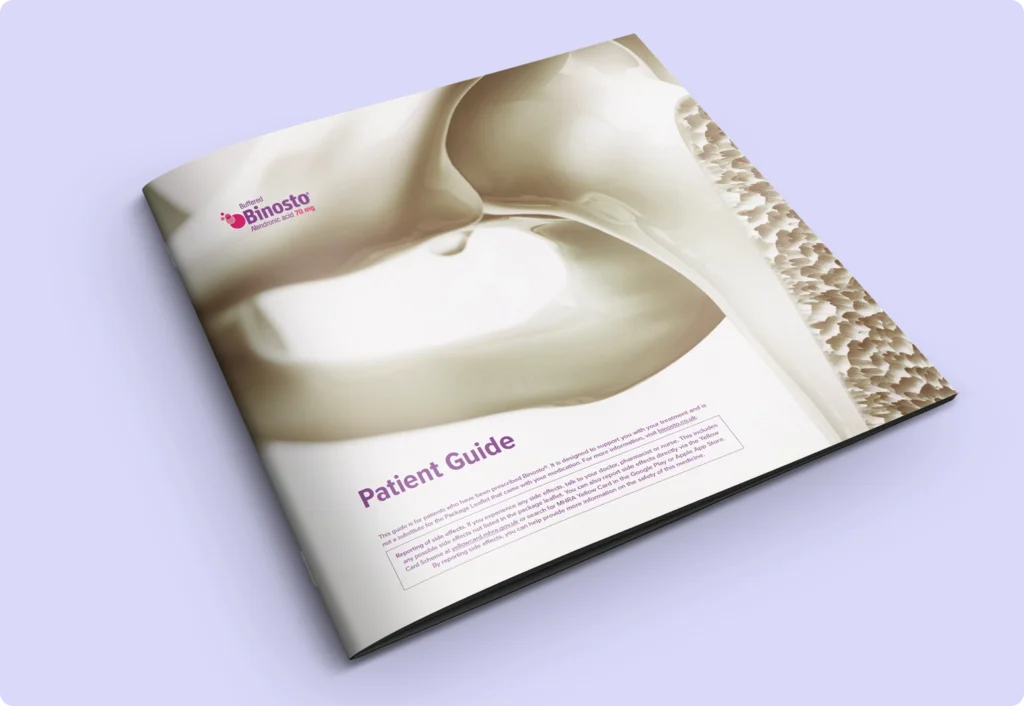
Binosto Patient Guide

Download your patient guide

Download this handy guide which offers valuable information, along with practical tips, for staying consistent with your treatment and improving your overall bone health.

Click here to download

References

1. Binosto® Summary of Product Characteristics. Accessed: July 2026. 2. National Institute on Aging. Osteoporosis. Accessed: July 2026. 3. NHS. Osteoporosis. Accessed: July 2026. 4. International Osteoporosis Foundation. About Osteoporosis. Accessed: July 2026. 5. Royal Osteoporosis Society. Osteoporosis Symptoms. Accessed: July 2026. 6. Johnell O, Kanis JA. Osteoporos Int. 2006;17(12):1726-33. 7. Yao P, et al. JAMA Netw Open, 2019;2(12):e1917789. 8. Royal Osteoporosis Society. Alendronate (alendronic acid). Accessed: July 2026.

Reporting of side effects. If you get any side effects, talk to your doctor, pharmacist or nurse. This includes any possible side effects not listed in the package leaflet. You can also report side effects directly via the Yellow Card Scheme at https://yellowcard.mhra.gov.uk. By reporting side effects, 
you can help provide more information on the safety of this medicine.
UK-BINO-48 | July 2026

The information on our patient website is solely intended for UK patients prescribed this medicine by a UK Healthcare Professional.

I confirm I am a UK patient

All other visitors, please view the Summary of Product Characteristics

Reporting of side effects. If you experience any side effects, talk to your doctor, pharmacist or nurse. This includes any possible side effects not listed in the package leaflet. You can also report side effects directly via the Yellow Card Scheme at https://yellowcard.mhra.gov.uk or search for MHRA Yellow Card in the Google Play or Apple App Store. By reporting side effects, you can help provide more information on the safety of this medicine.